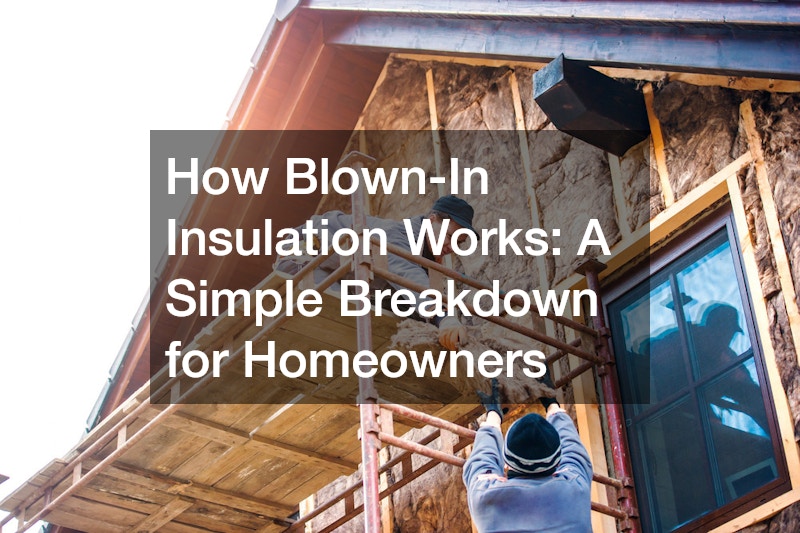

As energy costs continue to fluctuate, homeowners are constantly seeking effective ways to improve household comfort and trim monthly utility bills. One of the most impactful thermal upgrades you can make to your property is enhancing the attic and wall cavities with loose-fill insulation. Proper thermal protection prevents conditioned air from escaping while keeping harsh outdoor temperatures at bay. Understanding how this material functions, how it is applied, and why it outperforms traditional blanket insulation helps you make informed decisions when upgrading your home’s thermal envelope. Professional blown in insulation services offer a quick, minimally invasive solution to seal air gaps, eliminate drafts, and maintain stable indoor temperatures year-round.
What Is Blown-In Insulation?
Blown-in insulation—often referred to as loose-fill insulation—consists of small, lightweight strands or particles of insulating material packaged tightly in dense bales. Unlike traditional fiberglass batts or rolls that must be manually cut and laid flat between joists, loose-fill material is processed through a specialized mechanical blowing machine.
This motorized equipment shreds and expands the densely packed material back to its fluffiest state.
The blowing machine breaks up the compacted material, fluffs it with air to create thermal-trapping pockets, and propels it through a long, flexible hose directly into attics, floors, or wall cavities. This fluid application method allows the material to flow around structural obstacles, electrical wiring, pipes, and irregular framing, creating a seamless, continuous thermal blanket.
The Science Behind How It Works
To understand why loose-fill material is so effective, it helps to look at the basics of heat transfer. Heat naturally moves from warmer spaces to cooler spaces through conduction, convection, and radiation. In the winter, heat attempts to escape upward through your ceiling and attic. In the summer, solar heat radiating onto your roof attempts to push down into your living spaces. Without an adequate physical barrier, your HVAC system must run constantly to counteract this continuous heat exchange.
Insulation works by trapping tiny pockets of still air within its fiber network. Dead air is an exceptionally poor conductor of heat. By creating millions of microscopic air pockets, loose-fill insulation dramatically slows the rate of heat transfer through your home’s building envelope.
The effectiveness of any insulation is measured by its “R-value”—its resistance to heat flow. The higher the R-value, the greater the insulating performance. Because loose-fill material settles into every nook and cranny without leaving empty gaps or compressed spots, it delivers a consistent, uninterrupted R-value across the entire surface area.
Common Material Options
Homeowners typically choose between three main types of materials when hiring blown in insulation services:
- Fiberglass: Manufactured from recycled glass melted down and spun into fine fibers. Fiberglass is naturally fire-resistant, lightweight, and does not absorb moisture or support mold growth.
- Cellulose: Made primarily from post-consumer recycled paper, newsprint, and cardboard treated with non-toxic borate chemicals. Cellulose is highly eco-friendly, denser than fiberglass, and offers superior resistance to fire, pests, and air infiltration.
- Rockwool (Mineral Wool): Produced from molten basalt rock and industrial slag. Mineral wool is extremely dense, offers exceptional fire endurance up to high temperatures, and provides superior soundproofing performance between rooms or floors.
The Installation Process
The installation process for loose-fill insulation is straightforward, efficient, and typically completed within a single day. Experienced installation crews coordinate closely to ensure the material is applied evenly throughout the space.
First, technicians prepare the installation site. In an attic, this involves sealing major air leaks around light fixtures, plumbing stacks, and chimney flues. Baffles or eave vents are installed along the perimeter to ensure that the blowing process does not block crucial roof ventilation paths.
Next, one technician manages the hopper machine located in a service truck outside, feeding compacted material into the shredder. A second technician navigates the attic or wall space with the delivery hose.
As the fluffed material exits the hose, the installer coats the area to a precise, uniform depth corresponding to the target R-value for your climate zone. Depth gauges are often placed throughout the attic to verify that the proper thickness is met across every square foot. When insulating existing enclosed walls, small holes are drilled into exterior or interior stud bays, the hose nozzle is inserted to pack the cavity densely, and the access holes are sealed shut afterward.
Primary Homeowner Benefits

Investing in professional blown in insulation services provides several immediate and long-term benefits for residential properties:
- Seamless Coverage: Fills every void around wiring, joists, and pipes, eliminating thermal bridges where energy escapes.
- Lower Utility Bills: Keeps your HVAC equipment from working overtime, resulting in lower power bills and extended equipment lifespans.
- Fast and Low-Disruption: Machinery stays outside, running a single hose inside to minimize dust and household disturbance.
- Sound Dampening: Dense fiber networks absorb outside noise from traffic, heavy rain, and aircraft for a quieter interior.
Blown-in insulation combines simple thermal physics with efficient installation techniques to deliver one of the most cost-effective home energy upgrades available today. By trapping air in a continuous, void-free layer across your attic floor or wall cavities, loose-fill systems protect your home from temperature swings, lower utility expenses, and keep your living environment comfortable throughout every season. Investing in quality insulation is one of the quickest ways to enhance both your home’s energy performance and overall indoor comfort.